
Start a Gratiot County Property Records Search
Start with the county parcel lookup or FetchGIS. An address search returns a PIN, a taxing unit, and a legal description. Carry those identifiers into the deed index and the tax systems rather than matching on an owner name or a street label that may have changed. Names repeat. Streets get renamed. The parcel number does neither.
Remember what each source actually proves. The assessor roll is an administrative snapshot. The deed index is the recorded transfer trail. The Treasurer reports delinquent status, and the GIS map offers reference geometry, not surveyed boundaries.
- Search BS&A or FetchGIS by address and copy the complete PIN.
- Compare situs address, owner mailing address, unit, and tax description.
- Search the newest owner in Tapestry or Laredo and match the deed's legal description.
- Check assessment, tax status, GIS context, and any recorded plat.
- Use the courthouse counter, phone, mail, or focused FOIA request for missing material.
Where Gratiot County Keeps Property Records
Three offices hold the records. The Register of Deeds records land instruments, Equalization handles assessment and parcel access, and the Treasurer manages delinquent taxes and foreclosure files. All three sit at 214 E. Center Street in Ithaca, open weekdays from 8 a.m. to 4:30 p.m.
The Gratiot County Property Records Set
Every record answers a different question. Match your question to its custodian, then cross-reference results using the PIN and legal description.
| Record Type | What It Documents | Kept By | Access |
|---|---|---|---|
| Deeds | Transfers, parties, legal description | Register of Deeds | Remote paid search or counter |
| Mortgages and liens | Claims and releases | Register of Deeds | Index, image, copy |
| Assessment and tax | SEV, taxable value, delinquency | Equalization, assessor, Treasurer | BS&A, terminal, phone |
| Plats and parcels | Reference geometry, recorded lots | GIS Authority, Register | FetchGIS, plat copies |
| Building permits | Applications and inspections | City or county | Office request or FOIA |
For the title chain, turn to the deed records guide. For billing and delinquency, use the property tax records guide.
Limits of Gratiot County Property Records
Official records can establish a lot. A tax roll owner of record, a recorded transfer, assessed values, tax status, a permit event, and reference parcel geometry are all documented. Some questions stay open, though. No record alone proves occupancy, clear title, an exact boundary, condition, code compliance, or market price. Watch for mismatches, too. A mailing address and a situs address can differ, and a newly recorded deed may reach the recorder before the roll catches up.
Lawful use. Gratiot County records support due diligence, history, estate, and civic research. They do not replace a title professional or surveyor, and must never be used to harass anyone.
Three Gratiot County Search Systems
Three doors lead into the same county. BS&A is the assessment and tax door, FetchGIS is the spatial door, and the Register of Deeds Online Search Index is the document door. BS&A accepts address, owner, and parcel-number searches. FetchGIS adds intersection and coordinate modes plus selection, measurement, buffer, reports, printing, and CSV labels. Tapestry and Laredo cover the recorded land index.
| Starting fact | First system | Carry forward |
|---|---|---|
| Address | BS&A or FetchGIS | PIN, unit, legal description |
| Owner | BS&A | Mailing address and matching parcels |
| Buyer or seller | Tapestry or Laredo | Instrument and deed image |
| Nearby location | FetchGIS intersection search | Selected parcel IDs |
None of the systems replaces the others. Carry the stable property keys between them, and note the date of each search.
Free Gratiot County Parcel Terminals
Free parcel terminals wait in the courthouse lower level and the Treasurer's Office. No access fee applies. They are a strong fallback. An online account rule, a charge, or a browser failure can block a record. For printed output, Equalization lists copies at $1 per page. Fax service runs $5 per page. A prepaid phone lookup is $3, and hard-copy parcel information is $5 per parcel.
One free online lookup covers a taxpayer's own owner name, according to the county web page. Records under that same owner may stay free, while other searches can carry fees. An older delinquent-search page still carries a prior price-change notice. Confirm the current online charge before you buy. Counter staff can also point out records or years that are not exposed remotely.
Gratiot Deeds Span More Than 200 Categories
The Register of Deeds records more than 200 document types. Its land records reach back to the mid-1800s. The named examples run wide. Warranty and quitclaim deeds, land contracts, mortgages, liens, releases, powers of attorney, and oil-and-gas leases all appear in the index. Court judgments and orders affecting land may be recorded as well.
Land-record keys
A grantor conveys an interest; a grantee receives it. The legal description identifies the land, and the instrument or book-and-page reference locates the record itself.
What the office holds is not the same as what you can reach remotely. The county publishes neither Tapestry's earliest online year nor the imaging cutover date. Older searches may still run through counter indexes, deed books, cards, and microfilm.
Tapestry and Laredo Search Gratiot Land Records
The Online Search Index points casual users to Tapestry and regular users to Laredo. Tapestry charges $8.75 per search, with images at $1 per page. Laredo runs on a monthly fee. The county does not publish its exact Gratiot subscription rates or search limits. The official page lays out both services.
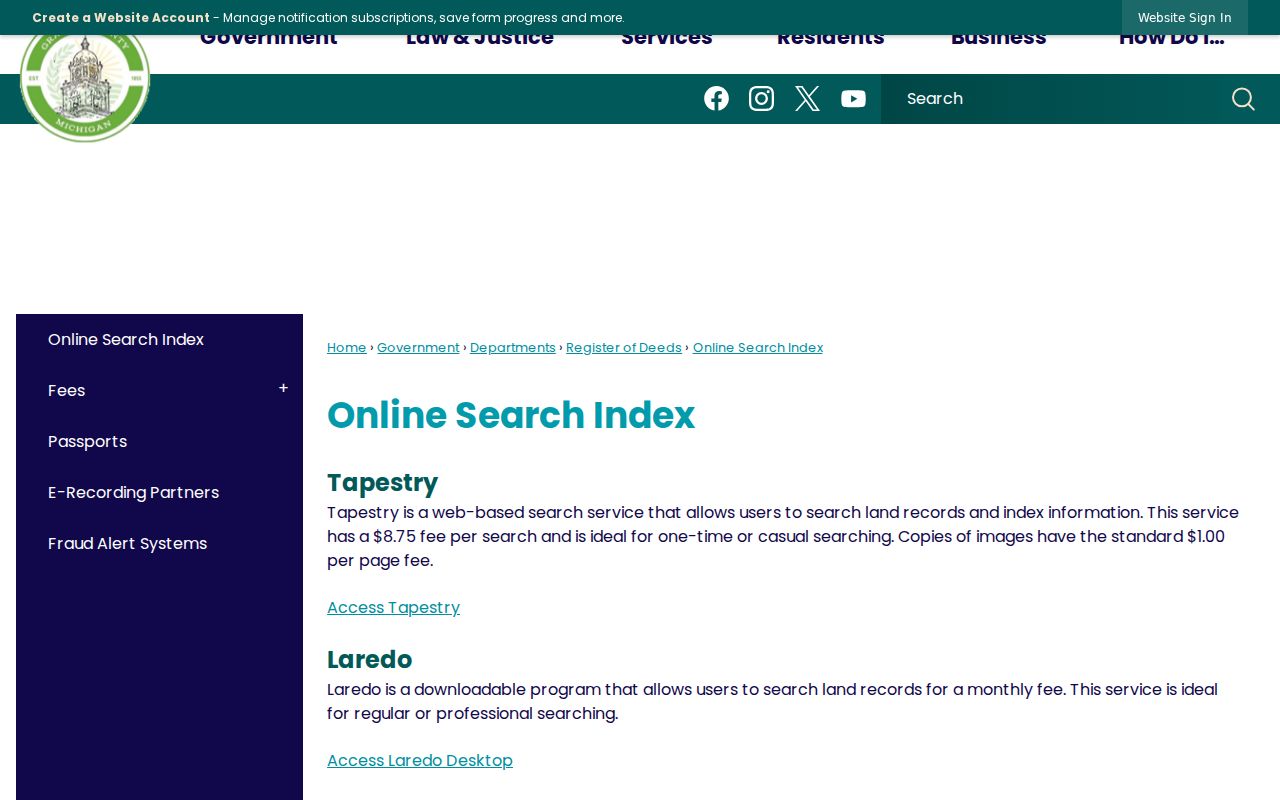
Accepted documents are timed, consecutively numbered, fully scanned, cross-indexed, and verified, according to the county. Search the buyer or seller, but confirm the legal description in the image itself.
Gratiot Assessment Has Three Value Fields
Michigan equalizes assessments at 50 percent of fair market value, Equalization states. A parcel report can show three fields: MBOR Assessed, Final SEV, and Final Taxable. Each field appears for the current and prior year. Taxable value may diverge from the others because of Proposal A rules and exemptions. None of these figures promises a market sale price. The Equalization page explains the scheme.
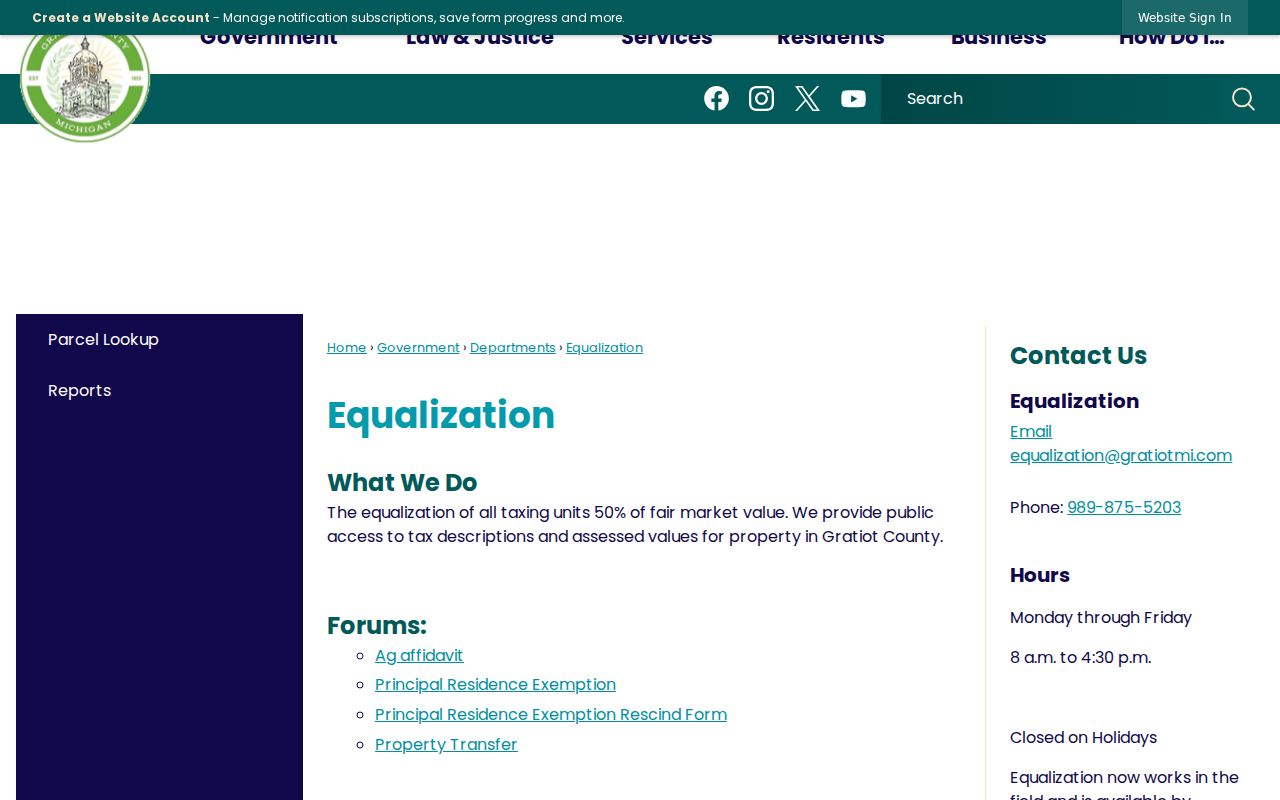
The 2026 report splits out the cities and 16 townships. Codes 051, 052, and 053 mark Alma, Ithaca, and St. Louis for assessment reporting, which helps separate a postal city from the actual taxing unit.
FetchGIS Builds a Gratiot Parcel Packet
The Gratiot GIS Authority viewer accepts a PIN, owner name, street address, intersection, or coordinates. One query can return a full report. That report template covers property and owner addresses, unit, tax-year values, acreage, zoning, frontage, land and building data, and sales information. It also includes any tax-history or delinquency sections that exist for the parcel. Map, property, tax, photo, download, print, and PDF controls are built in. Those controls make it easy to save a research packet.
The Buffer tool goes further. It selects nearby parcels, exports CSV data, or creates labels. Basemaps range from Open Street Map and Streets to Satellite and Dark Gray. The county viewer expressly disclaims legal-map and survey status. Rely on recorded plats, legal descriptions, and licensed survey work for boundary questions.
Gratiot Property Fraud Alerts Watch Filings
The county Fraud Alert Systems page offers two free safeguards for property records. One is a property-name alert. The other is a notary-name alert. The property service sends notice whenever a monitored name appears in a new recording. That recording happens at the Register of Deeds. The notary service works on daily, weekly, or monthly cycles. Each notice carries the document number, document type, and parties.
The county alert page appears below.
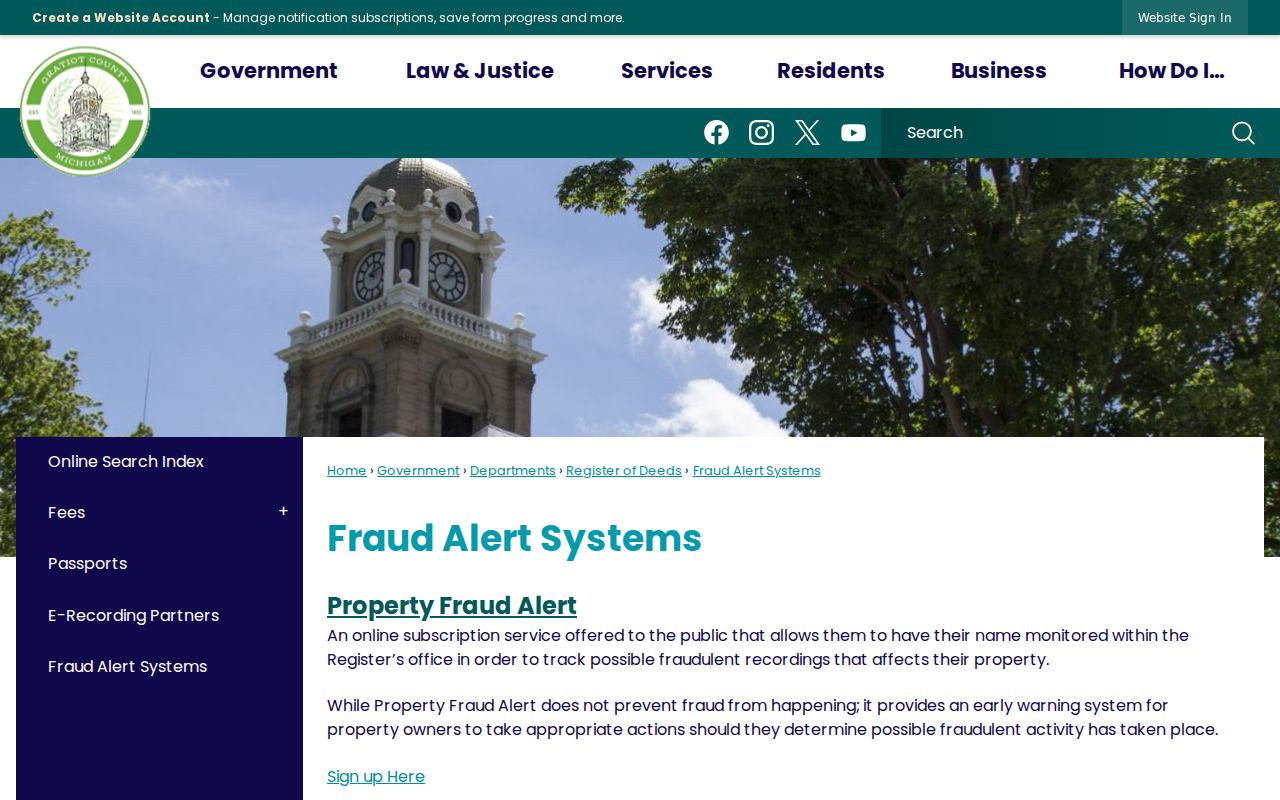
An alert is notice, not prevention and not proof of fraud. If a filing appears unauthorized, retrieve the instrument, contact the Register of Deeds, preserve evidence, and get legal help.
Gratiot Tax Delinquency Enters the Deed Record
Local tax bills start with the city or township. Payment stays there until March 1 of the following year. Older delinquent taxes then move to the county. Gratiot guidance describes a 4 percent administration fee and 1 percent monthly interest, followed by forfeiture, increased interest, and added charges. A notice of forfeiture is recorded with the Register of Deeds, so the delinquency enters the deed record itself.
The county's timeline is shown below.
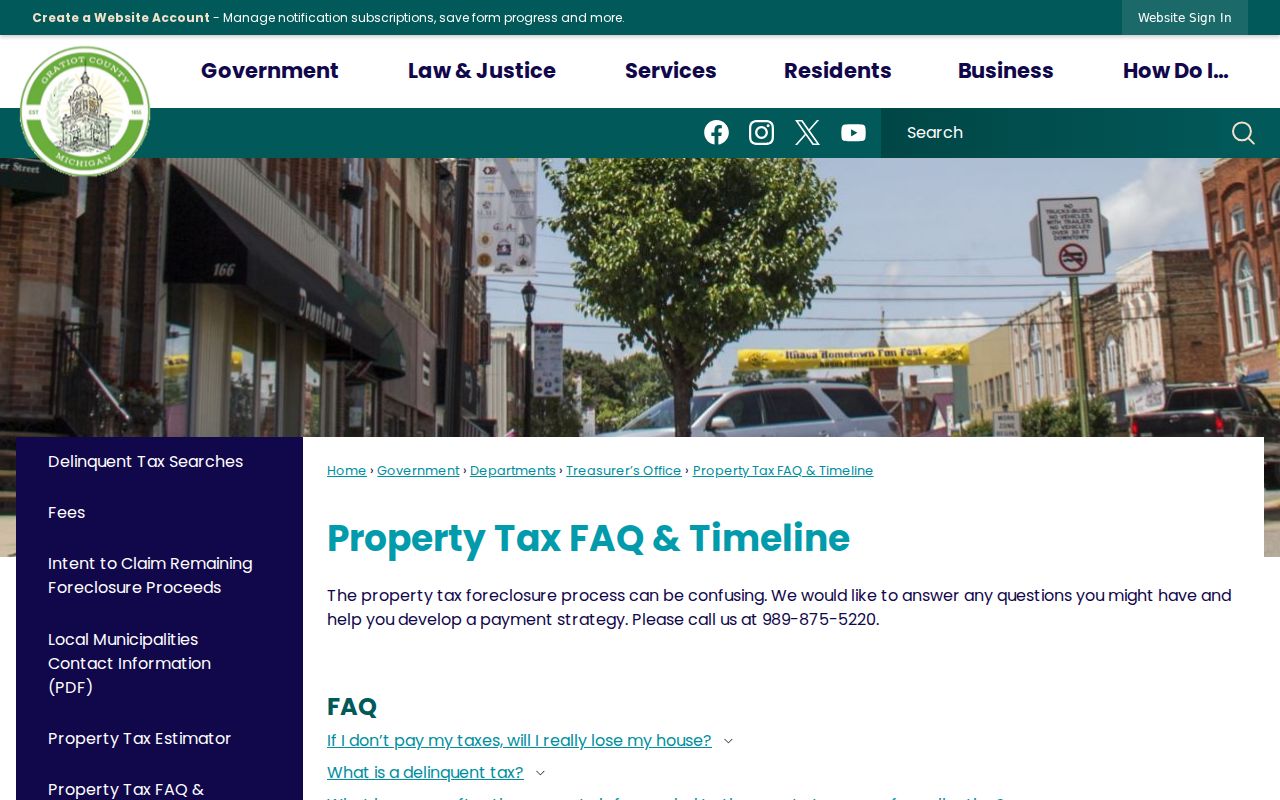
The 2026 Treasurer page lists an August 7 online foreclosure auction, but every date on it is time-sensitive. Delinquency, forfeiture, foreclosure, auction, and the eventual deed are separate stages, each with its own deadline.
Older Gratiot Property History Beyond the Portal
When the remote deed index ends, the courthouse takes over. Books, cards, and microfilm go back further. Staff help reaches older Gratiot County property records. The Gratiot County Historical and Genealogical Society Library adds maps, directories, county histories, family files, church and school sources, and obituaries. Courthouse research is available there too. Self-research there is free, though published copy and assisted-research fees apply.
These materials can name an occupant or an old institution. So may a street label or a family relationship. They cannot establish title. Treat every clue as a pointer back to the legal description and the recorded chain. That discipline matters most around Alma street changes, St. Louis's 1956 Westgate annexation, and Ithaca's Westwind development history.
Michigan FOIA Reaches Missing Gratiot Files
The county publishes no single address-keyed permit index covering Gratiot County and its cities. A records request can bridge that gap. The Gratiot County FOIA page supplies request and appeal forms, an excess-fee appeal, a cost worksheet, procedures, and a public summary. Ask for an identifiable record by address, PIN, record type, and date range.
Michigan public bodies generally respond within five business days. A single ten-business-day extension is allowed. Lawful fees can cover qualifying search and review, separation of exempt material, copies, and mailing. A permit or inspection file proves the event stated in that file, not title, completion, present condition, or a surveyed boundary.
Gratiot Courthouse Copies and Certified Records
Copies from the Register of Deeds follow a set fee schedule. An ordinary real-estate record copy costs $1 per page. Recorded plat copies run $3 per page. A staff name search costs $0.50 per year with a $5 minimum. Certification adds $5 per document, plus $1 per page. The whole document must be copied. These charges are separate from Tapestry's remote search fee.
A plain image often suffices for personal research. A transaction, court matter, or agency submission may require a certified copy. Ask the receiving party which form it needs before ordering. Give the office an instrument number or book and page whenever possible. Without one, provide grantor, grantee, approximate date, and legal description. That lets staff locate the correct document. Staff cannot be asked for a title opinion.
Equalization, the Treasurer, County Clerk, Probate Court, and Circuit Court each run their own copy channels. Their fee rules differ too. A certified deed does not also certify a tax balance, court judgment, or parcel boundary.
How Gratiot Records Cross-Check One Parcel
An address starts a search. The PIN and legal description tie the systems together. The assessor owner field is a roll snapshot, while the newest deed is the recorded conveyance. The tax account reports billing and delinquency. A recorded sale price is a transaction fact, not an appraisal, and GIS is a reference depiction rather than boundary evidence.
When records conflict, compare their dates and purposes. A recent deed can precede the assessor update. Michigan requires a Property Transfer Affidavit within 45 days, but Gratiot County does not publish a typical owner-field lag. A trust, estate, LLC, land contract, or life interest can also make the displayed names differ. Check the capacity stated in the instrument instead of forcing every source to match text for text.
An encumbrance review means searching mortgages, assignments, discharges, liens, releases, easements, restrictions, and court notices separately. A clean delinquent-tax result clears none of those claims.
Gratiot City and Township Edges
Gratiot County spans Alma, Ithaca, St. Louis, and 16 townships. Postal labels follow delivery routes, not legal boundaries. A single property near an edge can carry a city name that does not match its actual municipality. Write down the situs address, owner mailing address, ZIP, assessment unit, PIN, and legal description as separate facts. FetchGIS and the local tax unit settle the administrative geography when labels disagree.
Boundary history explains plenty of confusion here. Alma's official record shows a 2002 conditional transfer of 180 acres from Arcada Township. St. Louis annexed the 162-lot Westgate Park development from Pine River Township in 1956. Ithaca's planning map marks its downtown, the Business 127 corridor, Westwind Estates, and outlying farm edges. An older deed, a postal label, and the current taxing unit can therefore point three different directions at once.
Annexation changes government, not ownership. A street project never conveys private title either. Trace the parcel's legal description through the recorded deed chain, and take zoning or permit questions to the city or township that actually holds them.
Property Research with the Gratiot Courts
Land disputes travel through the 29th Circuit Court, the Probate Court, and other divisions. Foreclosures, quiet title actions, partitions, condemnations, injunctions, and estate administrations all generate dockets. Many later become recorded instruments. The MiCOURT Case Search offers informational docket access statewide. The clerk still holds the official file and certified copies.
Fees in Gratiot are modest. A ten-year civil or circuit search runs $12. Ordinary copies cost $1 per page. Certification adds $10 per document plus $1 per page. An electronic copy already imaged is listed at $2 for up to ten pages. Sealed and restricted records stay under court access rules.
Treat a docket as a lead, not a conclusion. Match the parties, the property description, the case number, and the judgment date. Then check for any later Register of Deeds recording. That way the litigation counts as part of the parcel's land record only when it belongs there.
A Lawful Gratiot Property Records Method
Gratiot County property records serve many lawful purposes. Buyers use them for diligence. Neighbors research boundaries and easements. Others review tax bills, settle estates, watch for deed fraud, trace house history, or simply check how government works. Ask only for the fields your property question needs. Michigan FOIA allows redaction of exempt material, including anything whose release would be a clearly unwarranted privacy invasion or a safety risk.
Michigan runs an Address Confidentiality Program for people facing violence, stalking, trafficking, or similar physical danger. It provides a substitute address and mail forwarding. The program cannot erase an old recorded deed, but it can shield certain current government-held address fields where the law allows. Never use owner names, mailing addresses, maps, or files to stalk, harass, threaten, or harm anyone.
Commercial data profiles go stale or merge records wrongly. Official records have faults too. The difference is that an official record names its custodian, shows the record date, and offers a correction route. Verify with the office that keeps it.