
What Gratiot County Deed Records Show
A recorded deed proves an instrument was accepted into the Gratiot County land record. Every entry names the parties. It lists the execution and recording dates, and it carries the legal description of the parcel. You can also read the consideration or transfer-tax context when shown. The recording reference ties the deed to the county's official index. The deed type matters too, since it shapes what the instrument says it conveys.
| Deed Type | What It Does | Common Use |
|---|---|---|
| Warranty deed | Conveys the stated interest with covenants | Ordinary sale |
| Quitclaim deed | Conveys whatever interest the grantor has | Family or title cleanup |
| Land contract | Records a contract interest | Installment purchase |
| Fiduciary deed | Conveys through an authorized estate representative | Probate transfer |
| Tax or foreclosure deed | Records a transfer after statutory proceedings | Tax foreclosure |
Not everything indexed beside a deed works like one. Mortgages, liens, easements, restrictions, and releases carry different legal weight. A deed search alone never proves a parcel is clear of encumbrances, so search those document families separately.
The Gratiot County Grantor-Grantee Trail
Gratiot County cross-indexes buyer names, seller names, and legal descriptions. Start with the newest known owner as grantee. Inspect that deed image, then treat its grantor as the grantee you hunt for in the next earlier instrument. Step back through the chain this way.
- Find the present owner's acquiring deed with the owner as grantee.
- Read the prior owner, legal description, and recording reference from the image.
- Search that grantor as an earlier grantee and repeat the legal-description match.
- Move to counter indexes, deed books, cards, or microfilm when remote coverage ends.
- Grantor
- The party conveying an interest.
- Grantee
- The party receiving the stated interest.
- Chain of title
- The ordered sequence of recorded conveyances for the same land.
- Book/page or instrument number
- The reference used to retrieve a recorded image or volume entry.
Get a Gratiot County Deed Copy
Copies carry set fees. Tapestry charges $1 per page after its $8.75 search. At the courthouse, a real-estate record copy costs $1 per page. Certification adds $5 per document plus $1 per page for the entire document. Plat copies run $3 per page. A staff name search costs $0.50 per year with a $5 minimum.
Visit or call the Register of Deeds at 214 E. Center Street, Ithaca, 989-875-5217, during weekday office hours. Provide the instrument number or book and page whenever you can. For mail and counter requests, identify the parties. Also give the approximate recording date and the land description.
Recorded, not guaranteed. Gratiot County deed records show accepted instruments, not a title opinion. Unrecorded interests and indexing errors can exist.
Tapestry or Laredo for Gratiot Deeds
The county Online Search Index offers two remote options. Tapestry suits occasional users, while Laredo serves regular searchers through a monthly subscription. Gratiot's exact Laredo rates, remote index start year, result limit, and full field list are not published by the county.
| Search clue | Verified basis | Caution |
|---|---|---|
| Grantor or grantee | Buyer and seller names are indexed | Exact live role label unverified |
| Legal description | County says it is extracted | Match the image, not an address alone |
| Document type | County names many recorded families | Dropdown is not published |
| Instrument or book/page | Documents are numbered and indexed | Exact result label can vary |
The successful capture below shows the official access choices.
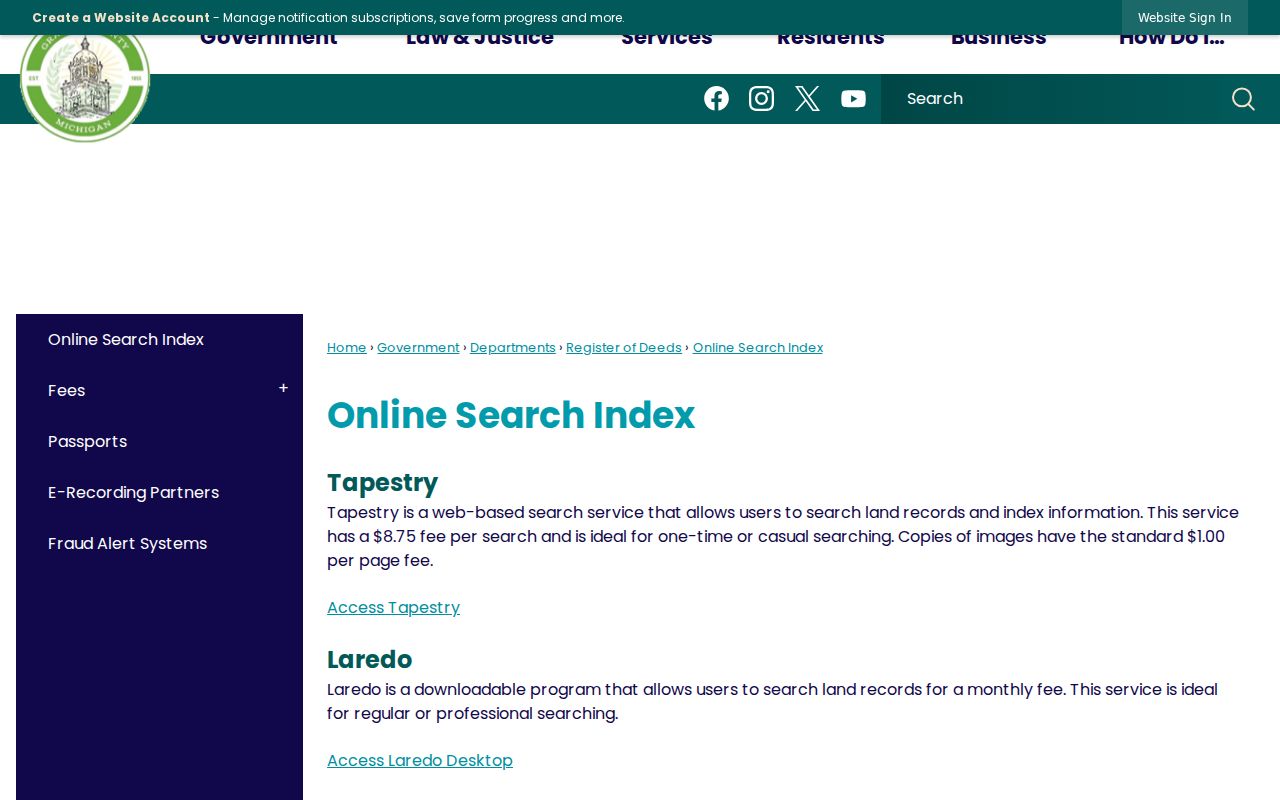
Use the county page, not an unverified third-party directory, to reach either product.
Gratiot Deed Holdings Reach the Mid-1800s
The Register of Deeds states that its land records date to the mid-1800s. That is close to Gratiot County's 1855 organization. The claim describes the office collection itself. It does not promise that every year or image is reachable through Tapestry or Laredo. No official source publishes the imaging cutover or the earliest remote index year.
For an older chain, ask the office for grantor and grantee books. Deed books, card indexes, and microfilm are also options. Hold the legal description constant while stepping through names. Today the office scans each accepted document in full and stamps it with a time and number. It cross-indexes the parties and description, verifies the entry, and returns the original. A Gratiot chain can therefore span paper ledgers and modern databases alike.
More Than 200 Gratiot Recording Types
The office records more than 200 document types, by its own count. The public list spans land contracts, mortgages, liens, oil-and-gas leases, powers of attorney, releases, quitclaim deeds, and warranty deeds. Courts add divorce judgments, orders, liens, and other property-related notices. Those published examples fall short of a full portal menu.
When researching a parcel, search each relevant document family. Do not assume a deed search catches every claim. An assignment can lead to a later mortgage discharge. A lis pendens may point to a pending court case. A plat or restriction can frame a whole development. A later release or amendment can rewrite the original terms.
Legal Description Beats a Changed Street Name
Street names in Gratiot County can change while the land description stays steady. Alma's official history records street work touching Adams Avenue and Grover Avenue. It also lists Center Street, Superior Street, and Warwick Drive. Postal cities can stretch into neighboring townships too. When an old deed carries an unfamiliar address, start with the parcel system.
Copy the current tax description and PIN, then compare the deed image itself. For a platted lot, record the subdivision, lot, block, and liber/page or instrument reference. For metes-and-bounds land, preserve the section, township, range, bearings, and distances. Never redraw a legal description from a GIS outline. Never shorten one either.
Note: The legal description is the durable cross-reference. It survives changes to a street label, mailing city, or parcel configuration.
Westgate Marks a Gratiot Deed Boundary Break
St. Louis history records that Westgate Park's 162-lot subdivision was formed from Pine River Township in 1956. It was annexed that same year. That year works as a search breakpoint for deeds, plats, assessment units, and old descriptions. A parcel could shift from township to city administration. No ordinary private sale was needed for the change.
Begin with the current parcel and its recorded plat, then trace each conveyance backward. The city assessor's Westgate Original and Westgate New analysis areas are valuation geography. They are not deed proof. This is why an annexation date, a plat name, and a legal description can settle a chain. Such a chain looks inconsistent when read by street or postal city alone.
Gratiot Fraud Alerts Monitor New Instruments
The county Fraud Alert Systems page links two services. One is Property Fraud Alert. The other is Notary Fraud Alert. A property alert watches chosen names in newly recorded documents. A notary alert can send daily, weekly, or monthly notices. Each notice lists document number, type, and parties whenever the subscribed notary name appears. The county's alert options are shown below.
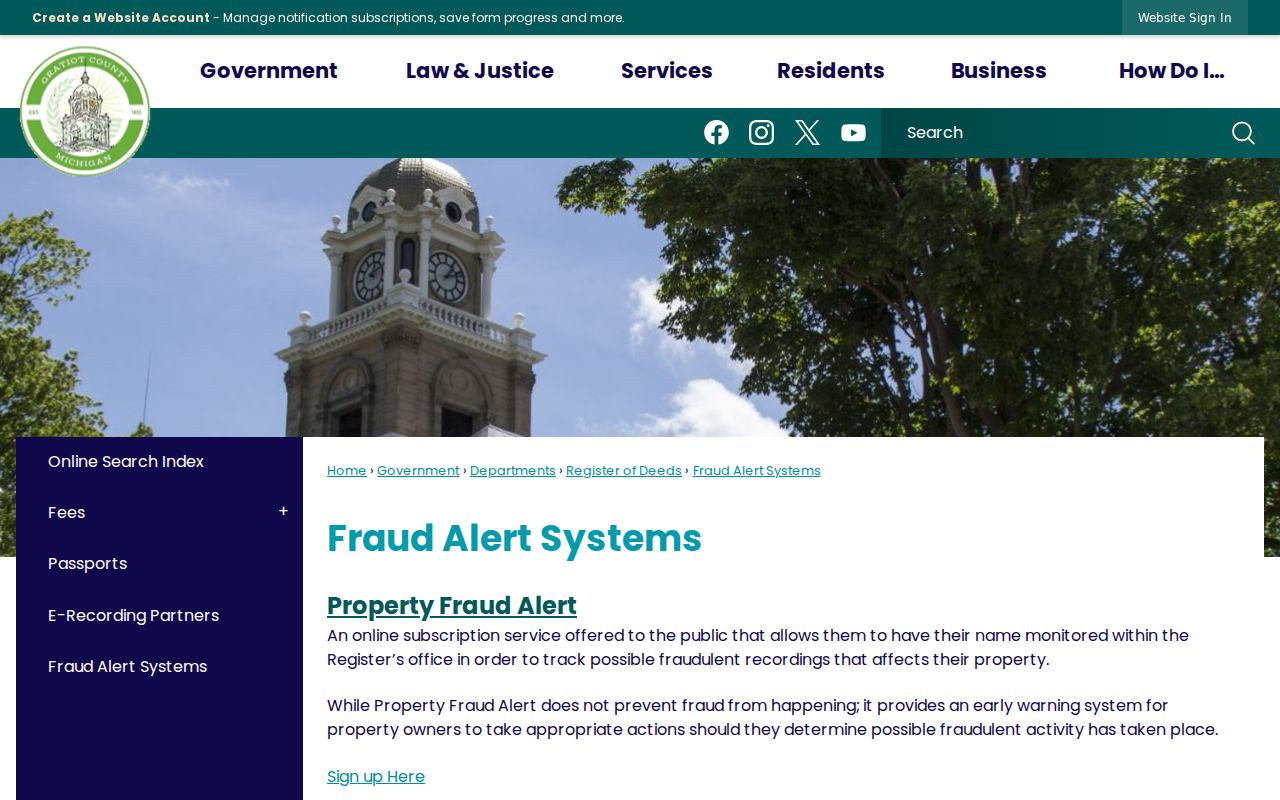
A fraud alert is only a warning. It never blocks a recording and proves no wrongdoing on its own. If a filing looks unauthorized, pull the instrument, keep its number and image, notify the Register of Deeds, and get legal advice on next steps.
When the Gratiot Deed Index Does Not Resolve the Chain
Sometimes the deed index alone cannot settle a chain of title. Probate records may insert an estate between owner names you recognize. A personal representative or trustee can appear as well. A deceased owner may remain on the tax roll. Search the Probate Court file alongside any recorded conveyance. A divorce judgment or other court order can also shape ownership and be recorded later. The 29th Circuit Court covers Gratiot and Clinton Counties. Certified files come from the clerk.
Older parties can resist identification. The Gratiot County Historical and Genealogical Society Library offers directories, obituaries, maps, family histories, and courthouse research. These materials help separate same-named people and explain a parcel's history. They cannot substitute for the deed chain, though. Or prove that an occupant actually held title.