
What Gratiot County Property Tax Records Show
A Gratiot County property tax record stacks up several distinct pieces. Valuation, exemptions, and millage sit beside billing, payment history, delinquency, and any foreclosure action. Keep the year and taxing unit attached to every number. Current bills start with the local unit, while delinquent accounts move up to the county, so the same parcel can appear in two places at once.
| Field | What It Shows | Where |
|---|---|---|
| MBOR Assessed | Board of Review assessment field | Parcel report or assessor |
| Final SEV | State equalized value | Assessment roll |
| Final Taxable | Value used with millage | Assessment and bill |
| PRE or exemption | Tax treatment where applicable | Local assessor |
| Tax and payment status | Current or delinquent account | Local or county treasurer |
Michigan assesses property at half of fair market value, and Gratiot County equalization keeps local rolls aligned with that standard. That 50 percent figure is the state equalized value. Taxable value can lag behind it because Proposal A caps growth, and exemptions chip away further. Neither number guarantees what a parcel would sell for.
Look Up a Gratiot County Tax Bill
The county's delinquent-tax instructions are one starting point, and the BS&A link off the Parcel Lookup page is another. Search by address or PIN, confirm the taxing unit and the owner of record, then open the matching year.
- Search by address, parcel number, or owner and verify the situs.
- Read the tax year, taxing unit, amount, and payment status.
- Compare SEV, taxable value, and any PRE or exemption with the assessor roll.
- Call the correct treasurer for a current payoff and check recorded forfeiture or foreclosure notices.
- Assessed value
- The local assessment before equalization.
- Millage
- The rates applied to taxable value for taxing authorities.
- Principal Residence Exemption
- A Michigan tax treatment reflected by the assessing office when qualified.
- Tax lien
- The public claim and statutory process tied to unpaid property tax.
Contest a Gratiot County Assessment
Take a disputed assessment to the local assessor first. Equalization names the city or township official who holds the property card. Go line by line through that card against the facts. Check the class, dimensions, acreage, buildings, condition, and recent comparable sales the office recorded. Ask that office for the current assessment notice. Request the Board of Review schedule and the required form. Appeal routes and deadlines are set locally, so confirm them before assuming any countywide date.
Appeal window. Gratiot owners should confirm the current local Board of Review deadline and filing method immediately after receiving an assessment notice.
Gratiot Equalization Uses the 50 Percent Rule
Gratiot County uses a simple rule for assessed values. Equalized assessment equals 50 percent of fair market value. The Gratiot County Equalization Department applies that standard countywide. It also posts assessment reports, tentative ratios, millage material, and forms. Assessor contacts, GIS tools, and parcel links are part of the same offerings. Equalization keeps every city and township assessing unit consistent. Each unit still maintains its own roll, though.
The department's page lays out the 50 percent rule in plain terms.
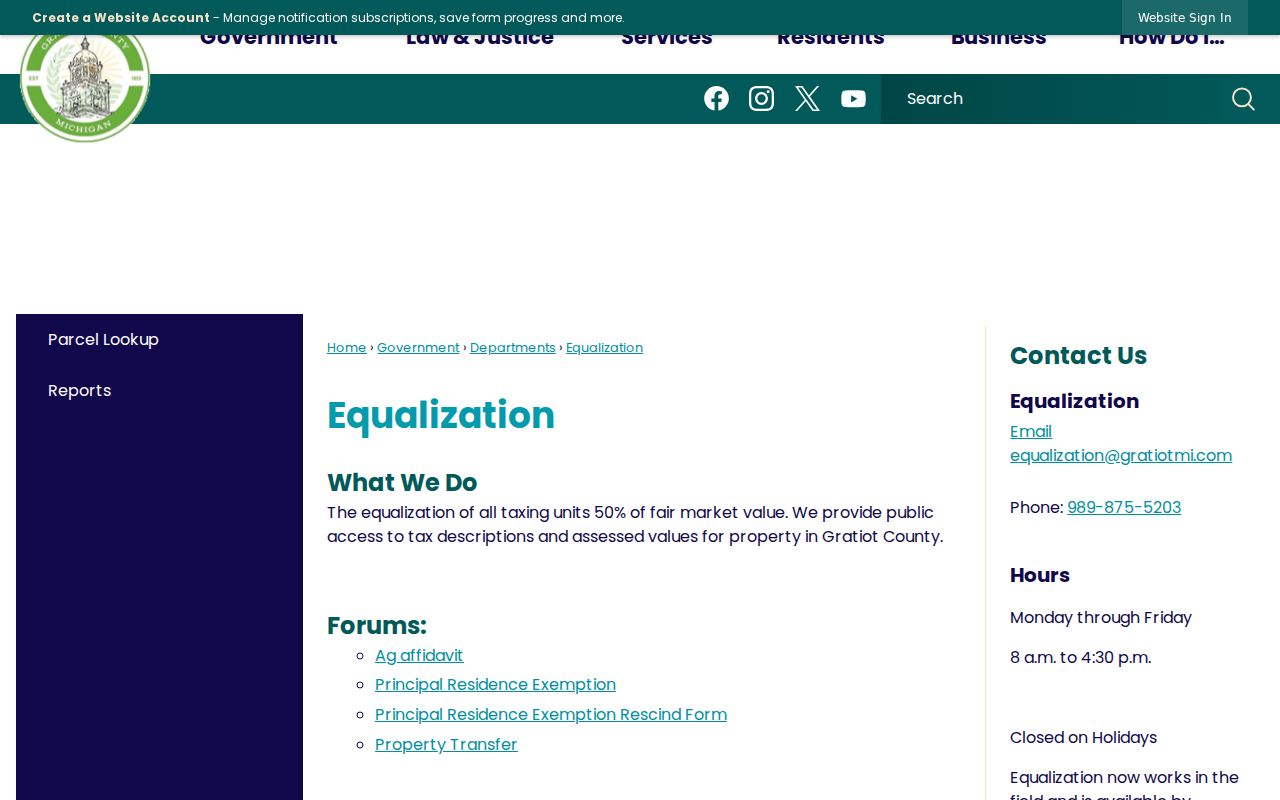
Find the assessing unit and value class in the report first. Then call that local assessor in Gratiot County to ask about a parcel-specific correction or review.
Gratiot Tax Search Access and Charges
Gratiot County's delinquent-tax page says BS&A accepts address, parcel, and owner searches. Owners and current residents can get extra free access after creating an account. Other users pay a per-record charge. One older notice on that page mentions a price change, so verify the amount in the live portal before you buy.
| Channel | Access | Published detail |
|---|---|---|
| BS&A web | Address, owner, PIN | Account and per-record rules |
| Courthouse terminal | Public access | No access fee |
| Printed page | Equalization | $1 per page |
| Phone lookup | Prepaid | $3 |
| Hard-copy parcel | Assessment or tax research | $5 per parcel |
The county's BS&A instructions are shown below.
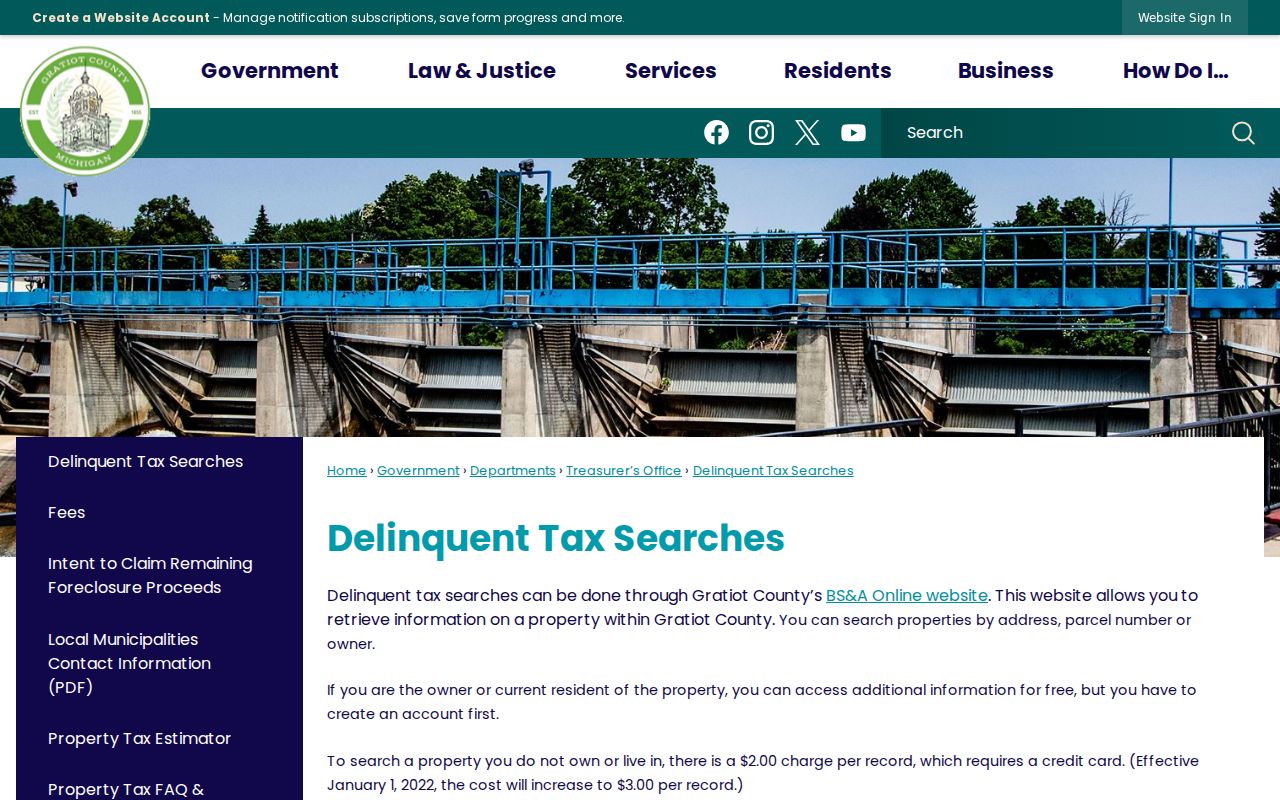
The counter and phone routes still work when a browser, account, or older tax year blocks the online Gratiot County lookup.
Current Tax Starts with a Gratiot Local Unit
A Gratiot County tax bill follows a two-step path. The Treasurer's 2026 guidance puts summer bills in the mail July 1. Winter bills go out December 1. Until March 1 of the following year, payments go to the local city or township treasurer. Then the account moves. Delinquent taxes belong to Gratiot County after that transfer. A searcher needs both the bill year and the collecting unit before writing a check.
Equalization assigns unit codes 051 to Alma, 052 to Ithaca, and 053 to St. Louis, plus the 16 townships. A mailing address can mislead you. Postal cities and ZIPs sometimes cross taxing boundaries in Gratiot County. Rely on the unit code, parcel number, and situs instead of the label on the envelope. For a payoff figure, call whichever office holds the account. Ask for the amount on your intended payment date.
The Gratiot Delinquency Timeline Becomes a Land Record
Unpaid taxes in Gratiot County turn delinquent the March 1 after the year they were due. The Treasurer then adds a 4 percent administration fee plus 1 percent interest each month. One year of delinquency costs the owner the property itself, at least on paper. The parcel is forfeited. Interest climbs to 1.5 percent monthly back to the delinquency date. At least $285 in fees piles on. The Register of Deeds records a formal notice of forfeiture. That puts the problem into the deed records for anyone to see. That step matters for a property search. It signals a cloud that a quiet title action may not cure.
Forfeiture is not the end. After 13 months, court foreclosure moves through the statutory process. Gratiot County describes the notice chain plainly. There are two first-class mailings, two certified mailings, one personal service, and possible publication in a newspaper. Each stage is distinct, so keep the terms straight. Delinquency is not forfeiture. Forfeiture is not final foreclosure. An auction listing is still not a recorded deed. The county's official tax timeline page lays out every deadline.
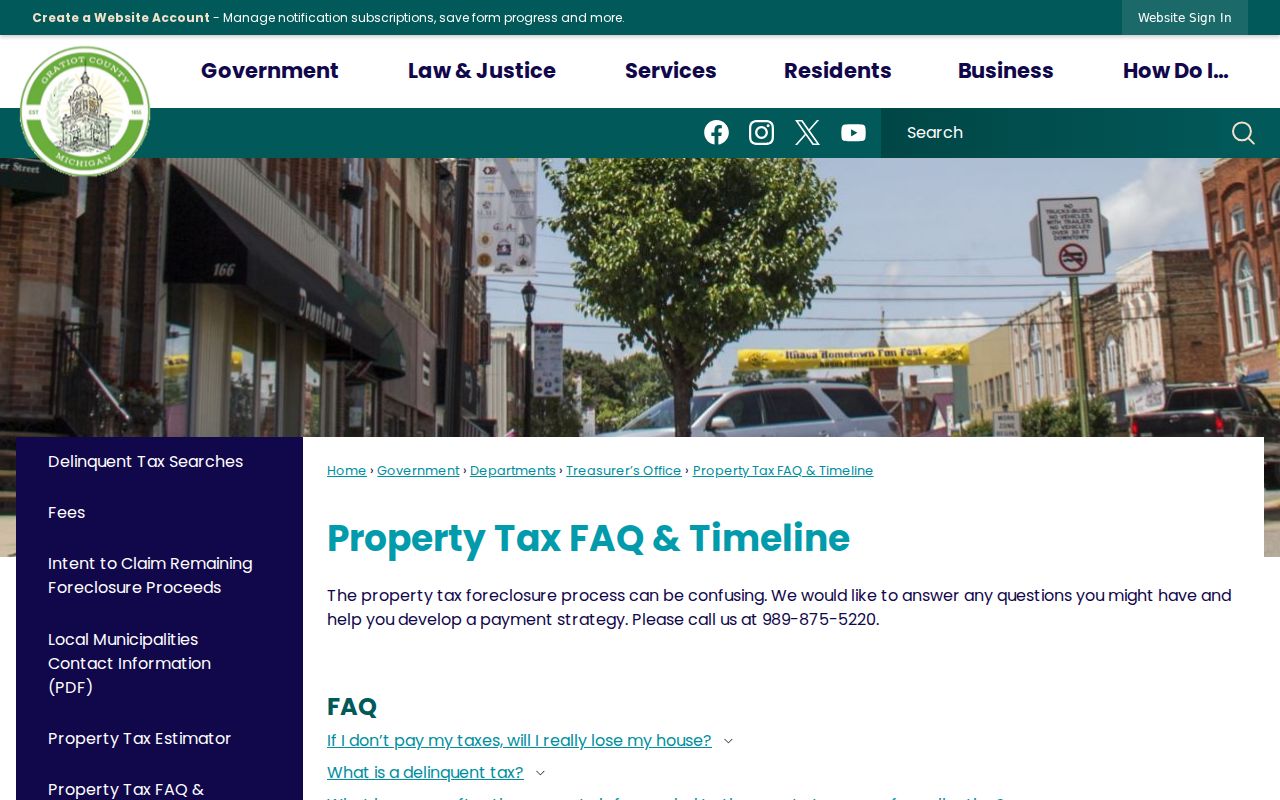
Check the live page because years, auction dates, interest, and costs are time-sensitive.
Gratiot's 2026 Tax Dates Need a Live Check
The Treasurer's page posts concrete dates for the current cycle. Taxes from 2025 enter forfeiture on March 1, 2027, then foreclosure on March 31, 2028. Taxes from 2024 reach foreclosure sooner, on March 31, 2027. The county has also scheduled its 2026 online foreclosure auction for August 7, 2026. Treat these dates as a snapshot rather than a fixed calendar. Each cycle brings new deadlines. The Treasurer's Office page carries the current schedule.

For tax sales, Gratiot County directs buyers to tax-sale.info. Auction rules allow six to eight weeks after cleared payment for deed execution and recording. Wait for that recorded deed before reading an auction result as current ownership of record.
PRE and Exemptions Change Taxable Value
A Principal Residence Exemption or another lawful exemption changes the taxable result. It does not touch the parcel's market evidence or recorded ownership. The local assessor handles the assessment roll and the supporting forms. The Treasurer and Register of Deeds play no part in that process. Exemption labels vary by parcel and by year. Inspect the parcel you have selected. Ask the assessor about any field that reads unclearly.
A transfer can change taxable treatment under Michigan law. A Property Transfer Affidavit is due within 45 days of a transfer. That filing updates assessing records. It is not the deed, though, and it does not guarantee an immediate owner-of-record refresh. Compare the affidavit status and the newest deed. Weigh the assessment year and the exemption year, too. Never assume every screen updates together.
Gratiot City Roll Changes Are Not Sale Trends
Gratiot County's 2026 equalization report counts 2,809 residential parcels in Alma. It counts 1,221 in Ithaca and 1,381 in St. Louis. Residential assessed value moved differently in each city. From 2025 to 2026 it rose 9.36 percent in Alma and 4.59 percent in Ithaca. It rose 8.51 percent in St. Louis, and taxable value shifted on its own track in every unit.
Read those numbers carefully. They are aggregate changes on the assessment roll, not a repeat-sales index. They are not evidence that any single parcel gained the same percentage. St. Louis shows why: commercial assessed value jumped 68.62 percent across just 122 parcels. That aggregate is easy to distort, because a small base, one large parcel, a reclassification, or routine assessment work can all skew it. For one property, rely on the parcel card. Rely on the local assessor's neighborhood analysis instead of the citywide rate.
Which Gratiot Office Answers the Tax Question
Different Gratiot County offices answer different property tax records questions. Equalization staff and the local assessor handle class and parcel-card details. They also handle SEV, taxable value, PRE, and review procedures. A current tax bill before a transfer belongs to the local treasurer. The County Treasurer takes delinquent payoffs, forfeiture, foreclosure files, and tax-sale administration. The Register of Deeds holds recorded forfeiture notices and any later deeds. The 29th Circuit Court file documents the foreclosure judgment itself.
Need a non-indexed administrative record? Request it through the county FOIA materials. Include an exact parcel, record type, and date range. And remember: a paid tax balance alone clears no title issue. It lifts no mortgage, private lien, easement, covenant, or other encumbrance.